Scalable Page Systems for SEO: How to Architect a 10,000-Page Site That Ranks, Gets Cited, and Doesn't Get Penalized
A systems architect's guide to scalable page systems for SEO. Five-layer architecture, HCU failure modes, 10 platforms compared (Webflow+Whalesync to Harbor to Invention Novelty), and the MCP angle.
By Invention Novelty · April 29, 2026
- 1A scalable page system is a five-layer architecture: data layer, template layer, content generation layer, schema/metadata layer, and observation layer. Most teams build layers 1-3 and skip 4-5.
- 2HCU casualties were overwhelmingly sites with layers 1-2 only (data + template substitution) with no per-page uniqueness, no schema, and no monitoring.
- 3Per-page research agents produce meaningfully more unique content than variable substitution - but cost more. Crossover point is ~5,000 pages where quality signals start catching thin content.
- 4The observation layer is what makes pSEO defensible: knowing which pages rank, which get cited in AI engines, which are being deindexed. Without it you're flying blind at scale.
TL;DR Comparison Table
What a Scalable Page System Actually Is
There is a persistent confusion between "having a lot of pages" and "having a scalable page system." Tripadvisor has tens of millions of pages. So did a hundred sites that got destroyed in Google's Helpful Content Updates. The difference is not page count - it is architecture.
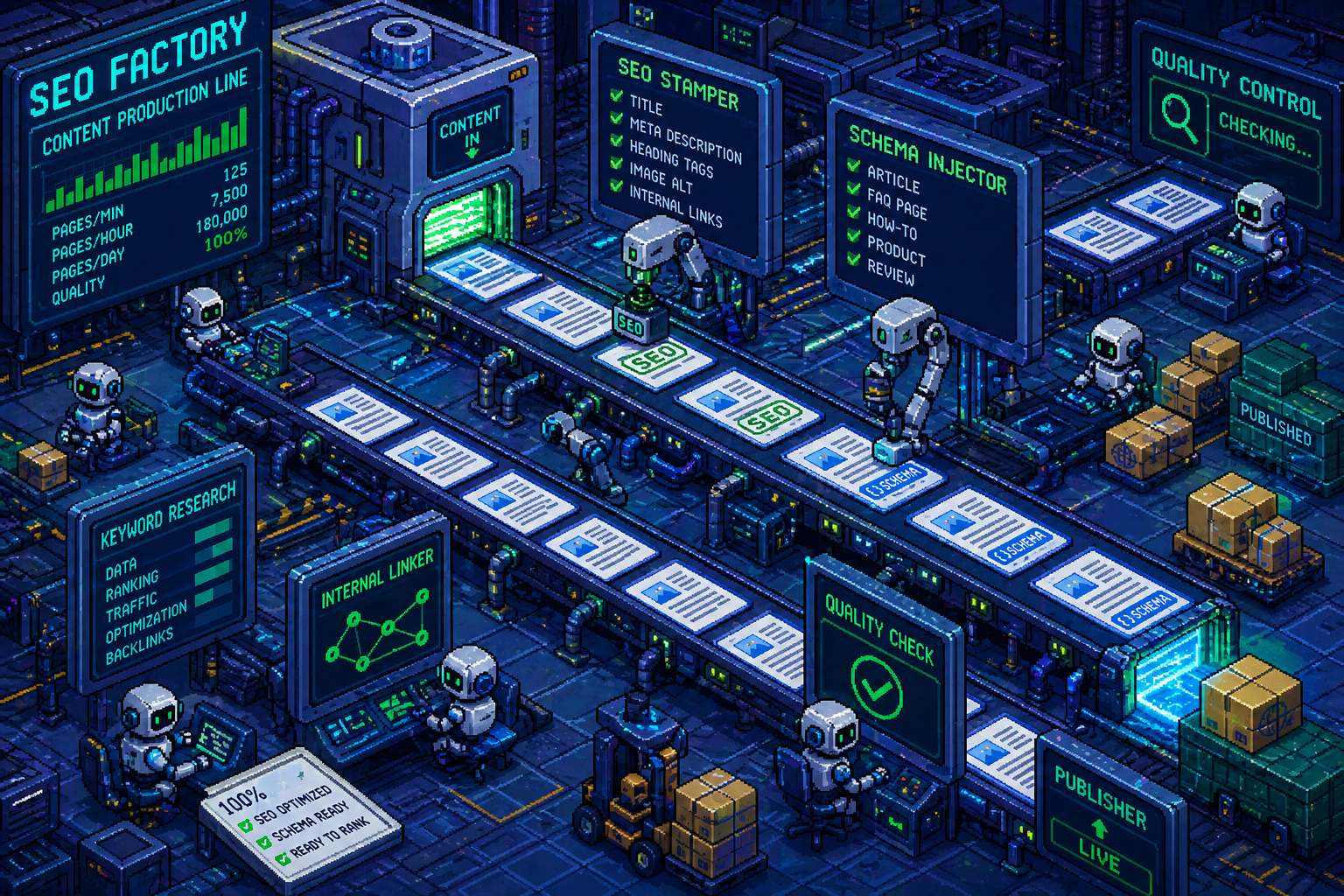
A scalable page system is a programmatic architecture that generates, manages, and monitors pages at scale based on structured data and defined rules. You do not write the pages. You define the system that writes the pages. The distinction is architectural: a CMS is a tool for managing content you create manually; a scalable page system is a factory that produces content according to specifications, maintaining quality and uniqueness at any scale.
The canonical examples of well-built scalable page systems have several things in common that make them worth studying:
NerdWallet runs a page system with millions of financial product pages (credit cards, loans, bank accounts, mortgages). Each page is generated from structured financial product data, but the content layer synthesizes actual editorial guidance - written by financial journalists and annotated with expert reviews - into the template. The data layer (financial product attributes) is entirely programmatic; the content layer includes meaningful human editorial. Schema is comprehensive (FinancialProduct, Organization, Review, FAQPage). The observation layer is NerdWallet's business intelligence infrastructure: they track ranking, click-through, and conversion for every page in their system.
Tripadvisor generates destination, hotel, restaurant, and attraction pages from a structured database of location entities, user reviews, and editorial content. The data layer is the most sophisticated in travel: each entity has structured attributes (price range, cuisine type, accessibility features, geographic coordinates), review aggregations, and media assets. Templates are rendered with location-specific content. Schema is comprehensive (Hotel, Restaurant, TouristAttraction, Review). The observation layer monitors ranking, review freshness, and entity data accuracy.
Zapier built a page system of integration documentation that is genuinely instructional rather than thin content: each "how to connect [App A] and [App B]" page is generated from a structured trigger-action database but includes specific, accurate integration steps, use case descriptions, and real-world workflow examples. The 30,000+ pages rank for highly specific integration queries because each page has genuine instructional value.
What these examples share: structured data as the foundation, templating that allows per-page variation, content that provides genuine value (not just variable substitution), comprehensive schema markup, and continuous monitoring of performance. They built all five layers - and it shows in their sustained rankings through multiple algorithm updates.
The sites that failed HCU did the opposite: pulled a data source, applied a template with variable substitution, published at scale, skipped schema, and had no observation layer to detect when ranking and indexation signals deteriorated.
The Four Properties of a Scalable Page System
Before getting into the five-layer architecture, it is worth naming the four properties that separate sustainable scalable page systems from the ones that get penalized. These properties are the "why" behind the layer architecture.
Property 1: Data-Driven
Every page should derive its existence from structured data, not from a human decision to write that particular page. This means your data source - whether a database, spreadsheet, API, or structured content repository - defines the universe of pages. A page exists because a data record exists; the page's content derives from that record's structured attributes.
Data quality is foundational. Garbage data produces garbage pages regardless of how sophisticated your template and content layers are. The most common pSEO failure mode is building a sophisticated page system on top of a poorly curated data set - duplicated records, missing attributes, inaccurate data, or low-specificity data that produces near-identical pages.
What data-driven means in practice: Before building the page system, audit your data set. For each record that will produce a page: Does it have enough unique attributes to produce a meaningfully different page from adjacent records? Is the data accurate and up-to-date? Is there a mechanism for keeping the data fresh over time? If you are building city landing pages for a SaaS tool, does each city record have enough unique content attributes (customer case studies, local regulatory context, city-specific statistics) to justify a distinct page?
Property 2: Per-Page Uniqueness
The biggest strategic error in pSEO is confusing variable substitution with per-page uniqueness. "Best [keyword] in [city]" pages that differ only in the substituted city name are not unique pages - they are the same page with a different label. Google's helpful content systems evaluate whether each page provides value beyond what adjacent pages already provide.
Genuine per-page uniqueness requires at least one of: unique structured data attributes that vary meaningfully per record, per-page research that surfaces entity-specific information not available in the base data, user-generated content that varies per page (reviews, Q&A), or dynamic freshness signals (local event data, current conditions, recent news for the page's entity).
The threshold shifts at scale. Sub-1,000 pages: moderate per-page uniqueness is acceptable. At 5,000+ pages: the system needs consistent mechanisms for per-page uniqueness because the variance in content structure and value that humans naturally produce when writing individual pages does not exist at scale unless explicitly engineered.
Property 3: Schema-Native
Schema markup should not be an afterthought applied retroactively to pages that already exist. In a well-designed scalable page system, schema is generated from the same structured data that generates the page content, simultaneously. The data record for a city + service page includes all the structured data needed to produce a valid LocalBusiness + Article + FAQPage schema block - because schema generation and content generation are driven by the same source.
Schema-native design means: schema types are mapped to data record types at the architecture stage, not the deployment stage. Adding schema to an existing page system retroactively is significantly harder than building it natively because schema requires the full structured data context that may not be preserved in rendered page content.
Property 4: Observable
Observability is the property that makes scalable page systems defensible over time. A system you cannot monitor is a system that can fail silently: pages being deindexed without your knowledge, schema markup errors accumulating across thousands of pages, AI citation share dropping for a page cluster while you are investing in expanding the system rather than maintaining it.
Observability means: ranking data per page at scale (not just aggregate traffic), indexation status across the full page set, schema validation coverage, AI engine citation share for representative pages in each page cluster, and crawl error monitoring. Without observability, you discover problems when traffic drops - which may be months after the underlying issue first appeared.
The Five Layers Explained
Layer 1: Data
The data layer is the foundation of the entire system. It is the structured data source that defines what pages exist, what each page is about, and what structured content attributes each page has access to.
Common data sources: Airtable is the most widely used pSEO data source in the mid-market - its familiar spreadsheet interface, column-typed data, linked records, and CMS-like views make it accessible without database expertise. For larger systems, Postgres or MySQL provides the query flexibility and performance needed for millions of records. Google Sheets works for small systems (under 5,000 records) but creates operational problems at scale due to sync limitations and API rate limits. Vector databases (Pinecone, Weaviate, Supabase with pgvector) are increasingly relevant for systems where semantic similarity between records determines page clustering and internal linking.
Data quality requirements. Every field in your data source that populates page content must have defined completeness requirements, validation rules, and a refresh mechanism. If a field is empty, what happens to the page? If the data is stale (a business has closed, a price has changed, a product has been discontinued), how does the page reflect that? These are operational questions that need answers at the architecture stage.
Data sourcing patterns. The best pSEO data is proprietary data you own: your own product database, customer records, operational data, research data. This data is not replicable by competitors who are building the same category of page system. Second-best is licensed third-party data with transformation - taking public or purchased data and enriching it with your own unique attributes. Weakest is publicly scraped data with minimal transformation, because every competitor doing the same analysis will have access to the same data set, producing near-identical pages with no competitive moat.
Freshness. Data in production should have scheduled refresh mechanisms. A page system for "restaurants in [city]" that was built with a data set from 2024 and never refreshed will increasingly diverge from reality - businesses close, hours change, new ones open. Stale data produces stale pages, which both mislead users and degrade freshness signals for search engines.
Layer 2: Template
The template layer defines how data records are rendered into web pages. It is the structural and visual framework that the data fills.
Template architecture. The two dominant approaches are: (a) dynamic rendering, where templates are processed at request time (Next.js dynamic routes, server-side rendered templates), and (b) static generation, where templates are compiled to HTML at build time (Next.js static generation, Astro content collections, Webflow CMS pages). Dynamic rendering allows real-time data integration and is better for rapidly-changing data; static generation is faster, cheaper, and more crawl-friendly but requires rebuilds when data changes.
Next.js dynamic routes ([city].tsx, [city]/[service].tsx) are the most flexible template approach for developer-built systems. The file-system routing makes URL structure explicit in the code; getStaticPaths and getStaticProps (or equivalent App Router patterns) generate pages from data at build time. Internal linking can be generated algorithmically from the data set, not manually.
Webflow CMS provides a no-code template approach where design and content structure are defined in the Webflow designer and data is populated through the CMS API or via tools like Whalesync (which syncs Airtable data to Webflow CMS in real-time). The constraint is Webflow's CMS item limits (2,000 items on most plans; Webflow Enterprise removes this) and the inability to do server-side logic within templates.
Astro content collections offer a developer-friendly static site generator that is particularly performant for text-heavy page systems. Astro generates pure HTML (no JavaScript unless explicitly added), which produces the fastest load times and most crawl-friendly pages in the category. The trade-off is less dynamic capability; for data that changes infrequently, Astro is often the best choice.
Template modularity. Large page systems typically have multiple template types: a hub template (city or category landing page), a spoke template (city + service or category + brand page), and a leaf template (most specific: city + service + individual record). Each template type should be separately maintained in the template layer, with shared components for elements that appear across template types (header schema, FAQ section, internal link section).
Layer 3: Content Generation
The content generation layer fills the templates with actual content - the text that appears on each page. This is where the most significant strategic decisions in pSEO architecture are made.
Variable substitution (the baseline approach). The simplest content generation is variable substitution: inject data attributes into template slots. "[City] is home to [count] [service_type] businesses, making it one of the most competitive markets in [state] for [service_type] services." This produces pages that are technically different but may not be substantively different - if the template is the same for every page and only the variables change, the pages are thin content at scale.
Variable substitution is appropriate for highly-specific leaf nodes in a page hierarchy (pages about individual product SKUs, specific location entities) where the structured data itself provides enough uniqueness. It is not appropriate as the sole content generation mechanism for hub or spoke templates, where the page needs to provide genuine synthesis and value rather than data display.
Per-page LLM generation (the scalable quality approach). A significantly better content generation approach uses an LLM to generate content per page, using the structured data attributes as context. Rather than substituting "[city]" into a template sentence, the LLM receives the full data record for a city - population, industry mix, nearby cities, relevant statistics, user-provided notes - and generates paragraph content that synthesizes this context into genuine, page-specific prose.
Per-page LLM generation produces meaningfully more unique content than variable substitution, but costs more (typically $0.01-$0.50 per page depending on model and content length) and requires content quality QA at scale. The crossover point in SEO value is approximately 5,000 pages: below 5,000 pages, the difference in citation and ranking performance between variable substitution and LLM generation is small enough that the cost may not be justified. Above 5,000 pages, quality signals (dwell time, click-through rate, AEO citation likelihood) diverge measurably.
Per-page research agents (the high-quality approach). The most sophisticated content generation approach runs a research agent for each page that actively queries external data sources (web search, database queries, API calls) to gather page-specific information before generating content. Harbor (reviewed below) is the leading tool using this approach. A research agent for a "best HR software for manufacturing companies" page would query recent industry data, pull relevant G2/Capterra reviews, find manufacturing-specific HR case studies, and synthesize all of this into a comprehensive, genuinely well-researched page.
Per-page research agents produce the highest quality content but at the highest cost ($0.08-$1.00+ per page, including API costs) and the longest generation time (minutes per page rather than seconds). For high-value page clusters where ranking competition is stiff and content quality is the determining factor, this approach is justified.
Layer 4: Schema and Metadata
The schema and metadata layer handles the structured data markup, canonical tags, hreflang, internal linking, and meta properties that make pages technically sound for search engines and AI engines.
JSON-LD schema generation. For each page type in the template layer, there should be a corresponding schema template that populates from the same data record. A city service page would generate: LocalBusiness (for businesses in the area), Article (for the page content itself with datePublished and author), FAQPage (for the Q&A section), and BreadcrumbList (for the navigation structure). Schema should be generated from structured data, not from rendered HTML - deriving schema from page content creates maintenance problems when the data changes.
Canonical and hreflang. At scale, canonical and hreflang management becomes complex. Pages need self-referential canonicals. Geographic variants (same-language, different-country pages) need hreflang linking to each other. Paginated content needs rel=prev/next (or pagination consolidation via canonical). These should be generated by the same data-driven rules that generate the page content - not managed manually.
Internal linking. Programmatic internal linking is one of the highest-impact Layer 4 investments. Rather than manually linking between pages, define rules: "hub pages link to all spoke pages in the same category," "spoke pages link to the three most closely related spoke pages in the same category," "leaf pages link back to their parent spoke page." These rules can be generated from entity proximity in the data set (using vector similarity, shared attributes, or explicit hierarchy in the data structure).
Meta properties. Title tags and meta descriptions at scale need template rules that avoid duplication and accurately describe each page's unique content. The temptation to use a single title template ("Best [service] in [city] | [Brand]") produces meta titles that are marginally different rather than meaningfully different. Better practice: generate meta titles and descriptions from the page's specific content attributes, ensuring that the strongest unique selling point of each page is reflected in the meta.
Layer 5: Observation
The observation layer is the most commonly skipped layer and the most consequential for long-term system health. It is the infrastructure for knowing what is happening to your pages after they are live.
Rank tracking at scale. Traditional rank tracking tools (Ahrefs, Semrush, SE Ranking) can track rankings for individual keywords, but most are not optimized for tracking thousands of pages programmatically. At page system scale, rank tracking needs to be organized by page cluster (all city pages for a given service type), reporting aggregate ranking distribution rather than individual keyword positions.
Indexation monitoring. Google does not index every page on a large site - it allocates crawl budget and makes indexation decisions based on perceived quality. Understanding which pages are indexed and which are not (using Google Search Console's Coverage report or direct API access) is critical for identifying quality signals that are preventing indexation. Common patterns: a cluster of pages in a geographic area is being indexed, but another geographic cluster is not; pages with schema errors are being indexed at lower rates; recently published page batches are indexing more slowly than expected.
AI citation monitoring. For pSEO pages that serve informational or comparison queries, monitoring AI engine citation rate for representative pages in each cluster identifies which content is being surfaced in AI-synthesized responses and which is not. This signals content quality (cited pages are considered higher quality by AI systems) and market share (your pages vs competitor pages in AI responses for category queries).
Schema validation at scale. Schema errors in a page system can silently affect thousands of pages. A systematic schema validation process (using Google Rich Results Test API or structured-data-testing-tool API) should run automatically when new pages are published and on a regular audit schedule.
Anomaly detection. The observation layer should alert when KPIs deviate from expected baselines: ranking drops across a page cluster (potential algorithmic impact), indexation rate drops below threshold (potential crawl budget or quality issue), traffic anomalies on specific page types, or schema error rate increases.
Common Failure Modes
Understanding the failure modes that led to Helpful Content Update casualties is the fastest path to avoiding them. The patterns are consistent across the sites that were most severely impacted.
Thin content at scale (Layer 3 failure)
The most common HCU failure mode: a page system with good data (Layer 1) and a solid template (Layer 2) that uses pure variable substitution for content (Layer 3). The result is thousands of pages that have different keywords in the URL and title but essentially identical content structure and value. Google's helpful content classifier treats these as thin content regardless of keyword targeting.
The tell: Pages with similar engagement metrics (short dwell time, high bounce rate, low CTR) across a large cluster despite strong technical SEO signals.
The fix: Per-page LLM generation with data-rich prompts, or per-page research agents for high-value clusters. Even adding a single unique paragraph per page - generated from a genuinely unique data attribute in the record - significantly improves the diversity signal.
Title cannibalization (Layer 4 failure)
When hundreds of pages share nearly identical title tag templates, internal competition for the same search queries depresses the ranking of all pages in the cluster. "Best HR Software in [City] | Company" produces titles that are semantically nearly identical to Google's intent classifier.
The tell: Multiple pages from the same domain appearing for the same query, with poor rankings for all of them.
The fix: Differentiate title templates by page type and cluster. Hub pages, spoke pages, and leaf pages should have structurally different title templates that reflect their different roles in the hierarchy.
Indexing throttle (Layers 1-2 failure, observation failure)
Publishing large batches of new pages simultaneously overwhelms crawl budget and triggers Google's quality filters - if a large batch of new pages arrives on a domain and the early signals (dwell time, click-through rate) are poor, Google will slow-walk indexation of the remaining batch.
The tell: Large batches of pages published but only a fraction indexed after 30+ days; Google Search Console Coverage report showing "Discovered - currently not indexed" for large page sets.
The fix: Stage publication at 100-500 pages per day. Implement IndexNow for immediate crawl notification. Ensure early-published pages have strong engagement signals before publishing subsequent batches.
Schema drift (Layer 4 failure, observation failure)
As page systems evolve - new template features, data schema changes, CMS migrations - schema markup can drift from valid implementations. A schema migration that introduces a single syntax error in the schema template produces schema errors across every page generated from that template.
The tell: Rich Results Test errors on pages that previously had valid schema; decline in rich result appearances in GSC.
The fix: Automated schema validation on every deployment and nightly audit of schema validity across a sample of live pages.
AI Overview omission
Pages in a pSEO system that would logically rank well for AI Overview inclusion but do not appear in them typically have Layer 3 failures (content is keyword-optimized but not structured for direct-answer retrieval) or Layer 4 failures (FAQPage schema missing, no clear Q&A sections in the HTML).
The tell: Strong Google organic rankings for a cluster with low AI Overview appearance rate for the same queries; competitors with weaker organic rankings appearing in AI Overviews for the same queries.
The fix: Add FAQPage schema to spoke and hub templates, restructure content openings for direct-answer formatting, increase entity density in the content generation layer.
Near-zero AI citations
Related to AI Overview omission but broader: pages in the pSEO system generate organic traffic but have essentially zero citation share in ChatGPT, Perplexity, or Gemini for corresponding conversational queries. This indicates that the content, while good enough to rank in traditional search, lacks the quality signals that AI retrieval systems use for citation selection: named entities, original data, structured Q&A, and direct-answer formatting.
The tell: Observation layer data showing strong rank positions but near-zero AI citation for the same page cluster; manual ChatGPT/Perplexity queries for category questions return competitor sources that have weaker organic rank but richer entity structure.
The fix: Content generation layer improvements targeting entity density, original data inclusion, and direct-answer paragraph structure. Schema layer improvements targeting FAQPage and Article schema with explicit author entities.
The 10 Platforms Compared
1. Invention Novelty
Layer coverage. All five layers (L1-L5): structured data management for data layer inputs, template-aware page generation for the content and schema layers, built-in schema generation and validation, and a full observation layer including rank tracking, AI citation monitoring, indexation status, and anomaly alerts. The only platform in this comparison with native coverage of all five layers.
Scale ceiling. Enterprise (1M+ pages). The architecture is designed for the scale requirements of large programmatic page systems; the observation infrastructure handles aggregate monitoring for large page clusters rather than requiring per-page manual review.
AEO/GEO awareness. The observation layer includes AI citation monitoring for ChatGPT, Perplexity, Gemini, Google AI Overviews, and Copilot. When citation share drops for a page cluster, the content generation layer can be triggered to regenerate at-risk pages with improved AEO signals. This is the only platform where the pSEO observation layer feeds directly into an AEO remediation workflow.
MCP/API. MCP server (production) and REST API. The MCP access enables agentic workflows: a Claude or GPT-4 agent can query page system health metrics, identify underperforming clusters, trigger content regeneration, and validate schema - all within an automated loop without human intervention.
Pricing. $79/month Solo (limited page system features), $299/month Growth (full pSEO, MCP access, 500 prompts, AI citation tracking), Enterprise custom.
Best for. Teams wanting full-stack pSEO with no gaps - data-to-observation in one workspace with the observation layer connected to the content layer through automated feedback loops. Particularly valuable for teams that want both pSEO and AEO/GEO tracking in the same workspace (the four-track SEO OS model).
Where it falls short. The breadth of capability means the platform has a steeper learning curve than single-purpose tools. Teams that only need one layer (e.g., content generation only) will find tools like Harbor or Cuppa.ai simpler for that specific layer.
Verdict. The most complete scalable page system platform available. The observation-to-content feedback loop is the defensibility layer that most teams skip when building pSEO systems.
2. SEOmatic
Layer coverage. L1-L3 (data, template, content) with partial L4 (basic schema generation). The L5 observation layer is not native to SEOmatic; external tools are required for rank tracking and AI citation monitoring.
What it does. SEOmatic is a purpose-built pSEO platform that integrates with multiple CMS environments (Webflow, Contentful, WordPress, custom builds) and provides a data management interface, template management, and AI-powered content generation. The CMS-agnostic approach is its primary differentiator - teams can use SEOmatic's data and content management on top of their existing CMS infrastructure rather than migrating.
Scale ceiling. Mid-market, approximately 50,000 pages. Above that, the performance of SEOmatic's content generation pipeline and the CMS integrations may become operational bottlenecks.
AEO/GEO awareness. Partial. SEOmatic incorporates some AEO content signals (direct-answer formatting recommendations) in its content generation templates but does not have citation tracking infrastructure.
MCP/API. REST API for data management and content generation triggers. No MCP server.
Pricing. $99/month Starter, $249/month Growth, $399/month Business.
Best for. Teams that have an existing CMS investment and want to add programmatic page generation without replacing their CMS. Strong choice for companies on Webflow or Contentful that want pSEO capabilities without migrating their site.
Where it falls short. Observation layer is absent; teams must add external rank tracking and AEO monitoring. Schema generation is basic. No MCP access for agentic workflows.
Verdict. Solid L1-L3 solution for CMS-integrated pSEO. Budget for external observation tooling.
3. Harbor
Layer coverage. Primarily L3 (content generation) with support for L1 data inputs and partial L2 (content-to-template output). Harbor is not a full page system; it is a high-quality content generation layer designed to sit within a larger architecture.
What it does. Harbor's core innovation is per-page research agents: for each page to be generated, a Harbor agent autonomously researches the topic - querying web sources, academic databases, industry reports, and knowledge bases - before generating the page content. The result is content that is more substantively unique and empirically grounded than what standard LLM generation produces.
Scale ceiling. Mid-market, approximately 20,000 pages at reasonable cost. The per-page research agent model is inherently slower and more expensive than template-based generation; very large page systems require careful cost management.
AEO/GEO awareness. Partial. Harbor's research agents naturally produce content with higher entity density and more original data - the properties that improve AI citation - because the agents pull in current, attributed information from authoritative sources. This is indirect AEO improvement rather than explicit tracking.
MCP/API. API for batch job submission and content retrieval. No MCP server.
Pricing. Approximately $0.08-$0.40 per page depending on research depth and content length. No monthly platform fee; pay-per-generation.
Best for. Page systems where quality is the primary constraint: high-competition categories where thin content will simply not rank, or programs where AI citation share is a KPI that requires genuinely substantive content.
Where it falls short. Harbor provides content, not a complete page system. Teams still need the data layer (Airtable, database), template layer (Next.js, Webflow), schema layer, and observation layer from other tools. Harbor is the content generation engine, not the full architecture.
Verdict. The best-in-class content generation layer for high-quality pSEO. Best combined with Invention Novelty's schema and observation layers or a custom architecture for a full-stack system.
4. Webflow + Whalesync
Layer coverage. L2 (template, deep) and partial L1 (data sync via Whalesync). The combination handles design, template management, and data synchronization from Airtable or Google Sheets into Webflow CMS items.
What it does. Webflow is a design-first visual website builder with a CMS that allows data-driven page generation from CMS collections. Whalesync is a third-party sync tool that connects Airtable or Google Sheets to Webflow CMS, keeping the two in sync (data changes in Airtable automatically update Webflow CMS items). Together, they form a no-code pSEO stack.
Scale ceiling. SMB, approximately 10,000 pages (Webflow's CMS item limits). Webflow Enterprise removes the hard limits, but cost scales significantly with item count. Not suited for 100,000+ page systems.
AEO/GEO awareness. None native. Schema markup requires manual implementation in Webflow's embed code blocks; there is no native schema generation from CMS data.
MCP/API. Webflow's CMS API and Whalesync's API. Reasonable for mid-size automation; not suitable for enterprise-scale orchestration.
Pricing. Webflow CMS plan from $29/month; Webflow Business from $49/month. Whalesync from $39/month. Combined cost approximately $79-$150/month for a functional no-code pSEO stack.
Best for. Design-conscious teams at the SMB/startup stage that want visually polished programmatic pages without developer involvement. The best no-code option for sub-10,000 page systems.
Where it falls short. Scale limitations are real. No native schema generation. The content layer is entirely dependent on what data is in Airtable - no AI content generation, no per-page uniqueness mechanisms beyond the data itself. Schema, observation, and content generation layers all require external tools or custom code.
Verdict. Excellent starting point for no-code pSEO. Plan your migration path to a more capable system as you approach 5,000-10,000 pages.
5. Sanity + Custom Architecture
Layer coverage. L1-L2 with DIY potential for all layers. Sanity is a headless CMS that serves as both a data/content repository (L1) and a template-backing structure (L2 via any frontend framework). All other layers require custom development.
What it does. Sanity provides a structured content repository with a flexible schema definition (via GROQ and schema files), a CDN-backed content API, and real-time content updates. For developer teams, it is the most flexible and powerful headless CMS for backing a large-scale page system - you control every aspect of the data model, content types, and API structure.
Scale ceiling. Technically unlimited. Sanity scales to millions of documents; the actual ceiling is set by your frontend and hosting infrastructure.
AEO/GEO awareness. Entirely DIY. Teams using Sanity can build AEO signals into their content schema (defining Answer and FAQPage content types natively), but there is no native AEO tracking or AI citation monitoring.
MCP/API. Full API access. Sanity's GROQ query language provides powerful querying for content retrieval. Can be integrated into agentic workflows via custom code.
Pricing. Free for small projects (up to 3 users, 100k API calls/month). Growth at $15/month/user. Teams/Enterprise custom. Very accessible pricing for the capability provided.
Best for. Technical teams who want maximum architectural control and are prepared to build the schema, content generation, and observation layers themselves. The right choice when your page system requirements are genuinely unique and do not fit into any existing platform's model.
Where it falls short. Everything above L2 is custom work. For teams without strong engineering capacity, the DIY overhead of Sanity-based architecture can be significant. No pSEO-specific tooling.
Verdict. The most architecturally flexible option. Justified only for teams with genuine custom requirements and the engineering capacity to build above L2.
6. Next.js + Airtable
Layer coverage. L1 (Airtable as data source) and L2 (Next.js as template/rendering layer) with DIY potential for all other layers.
What it does. The canonical developer DIY stack for pSEO. Airtable provides the structured data management interface; Next.js provides the dynamic routing and static generation capabilities for page production. The combination is familiar to most growth engineers and provides maximum flexibility in URL structure, routing logic, and data transformation.
Scale ceiling. Enterprise. Next.js and Airtable scale independently; the practical ceiling is set by Airtable's API rate limits (5 requests/second on standard plans) for large rebuilds, which can be worked around with caching. Beyond 100,000+ records, a Postgres or similar database is more appropriate than Airtable.
AEO/GEO awareness. DIY. Developers can implement any schema or AEO signal in the Next.js templates; nothing is provided out of the box.
MCP/API. Full API access to both Airtable and the custom Next.js application. Can be integrated into any agentic workflow.
Pricing. Infrastructure cost (Vercel hosting, Airtable subscription). Airtable Team plan at $20/user/month; Vercel Pro at $20/month. Total approximately $40-$100/month for the platform layer.
Best for. Developer-led teams that want maximum control and are comfortable building L3-L5 capabilities (content generation, schema, observation) as custom code or via point-solution integrations.
Where it falls short. Everything above L2 is engineering work. Schema generation, content quality, and observation infrastructure all require custom implementation. Not suitable for non-technical teams.
Verdict. The classic pSEO developer stack. Powerful and flexible; requires engineering investment to reach the full five-layer architecture.
7. Astro + Airtable
Layer coverage. Same as Next.js + Airtable (L1-L2) with one key difference: Astro generates pure static HTML by default, resulting in significantly faster page loads and simpler crawl behavior.
What it does. Astro is a static site generator that outputs pure HTML + minimal JavaScript, making it the fastest-loading developer option for content-heavy page systems. For pSEO pages that are primarily text-based and do not require client-side interactivity, Astro produces better Core Web Vitals scores than Next.js by default.
Scale ceiling. Large (500,000+ pages). Astro's static build approach means full-site builds can be slow for very large sites (rebuilding 500k pages from scratch takes time), though incremental builds mitigate this.
AEO/GEO awareness. DIY. All schema and AEO signals are custom implementations.
MCP/API. Full API access.
Pricing. Same infrastructure cost as Next.js + Airtable. Astro itself is free and open-source.
Best for. Developer teams prioritizing page load performance and Core Web Vitals, building content-heavy page systems where interactivity is not required. Strong choice for information sites, location pages, and documentation-style page systems.
Where it falls short. Same as Next.js: L3-L5 are custom work. Less ecosystem support than Next.js; fewer examples and third-party integrations.
Verdict. The best performance-optimized developer stack for text-heavy pSEO. Choose Astro over Next.js when page load speed is a primary ranking concern.
8. Letterdrop
Layer coverage. L2-L3 (template and content generation) with content-ops focus. Letterdrop is a content marketing platform that has added programmatic template capabilities to its existing content production workflow.
What it does. Letterdrop manages content production workflows (briefs, drafts, review, publication) and has added programmatic page templates for teams producing repeatable content at scale. The programmatic features are extensions of the content ops workflow, not a dedicated pSEO architecture.
Scale ceiling. Mid-market, approximately 25,000 pages. Better suited to teams producing 50-200 programmatic pages per month than to teams building full large-scale page systems from scratch.
AEO/GEO awareness. Partial. Letterdrop's content quality scoring incorporates some AEO signals (Q&A structure, entity completeness) in its editorial workflow.
MCP/API. REST API.
Pricing. $995/month and above. Higher price point reflects the content ops infrastructure alongside pSEO capabilities.
Best for. Content-heavy organizations that produce a mix of editorial and programmatic content and want both managed in a single platform. Not the best choice for dedicated pSEO programs.
Where it falls short. Data layer (L1) and observation layer (L5) are not native. Schema generation is limited. The content ops heritage means the product is optimized for editorial workflows, not data-driven programmatic systems.
Verdict. Better as a content ops platform with programmatic features than as a pSEO system. Consider for teams where editorial and programmatic content coexist.
9. Sight AI
Layer coverage. L3 (content generation, primary) and partial L4 (basic meta generation and indexing pipeline). Sight AI combines AI content generation with an automated indexing submission pipeline - a useful L3-L4 combination that most content generation tools do not provide.
What it does. Sight AI generates AI content for programmatic pages and includes IndexNow integration for submitting new pages to search engines immediately upon publication. The content generation uses templated prompts with per-page data injection, producing content that is more structured for search than raw LLM output.
Scale ceiling. Mid-market, approximately 30,000 pages. The indexing pipeline is a useful addition that Sight AI incorporates natively.
AEO/GEO awareness. None native. No schema generation, no AI citation tracking.
MCP/API. REST API for batch content generation.
Pricing. Approximately $0.05-$0.20 per page depending on content length and generation options. No monthly platform fee.
Best for. Teams that have data and template layers in place and need AI content generation with automated indexing submission. The IndexNow integration is a practical time-saver.
Where it falls short. No data layer, no template layer, no schema generation, no observation. Sight AI is a content generation + indexing submission tool, not a complete pSEO platform.
Verdict. Useful L3-L4 addition to an existing page system architecture. The IndexNow integration is its distinguishing practical value.
10. Cuppa.ai
Layer coverage. L3 (content generation) only. Cuppa.ai is the lowest-cost AI content generation option in the category, offering a BYO (bring your own) API key model that allows teams to use their own OpenAI, Anthropic, or Groq API credits for content generation.
What it does. Cuppa.ai provides a template-based content generation interface with batch processing, allowing teams to generate hundreds or thousands of pages from a CSV or spreadsheet input. The BYO API key model means generation cost is transparent and controlled - you pay the underlying model's API rate rather than a platform markup.
Scale ceiling. Mid-market, approximately 50,000 pages (limited by API rate limits, not platform limits).
AEO/GEO awareness. None. Basic content generation with limited AEO-specific structuring.
MCP/API. BYO API key integration. No native MCP or REST API for the platform itself.
Pricing. Platform fee from approximately $29-$79/month; content generation cost is your direct API cost. At GPT-4o-mini rates, content generation can cost as little as $0.01-$0.05 per page - the lowest effective cost per page in the category.
Best for. Cost-sensitive teams that need high-volume AI content generation and are comfortable with BYO API key infrastructure. Good for projects where per-page content cost is the primary constraint.
Where it falls short. Minimal quality controls, no schema generation, no observation layer, no data management, limited template sophistication. Cuppa.ai generates text; everything else is your responsibility.
Verdict. The lowest-cost content generation option. Requires a complete external architecture for L1, L2, L4, and L5. Consider as the content layer in a DIY stack where cost is the binding constraint.
A Reference Architecture
Invention Novelty's recommended five-layer reference architecture for a 10,000-page scalable page system, designed to serve both ranking and AI citation goals:
Layer 1 (Data): Airtable (for SMB/mid-market) or Postgres (for enterprise) as the structured data source. Each record includes: entity name, geographic attributes (city, state, country, geo coordinates), category attributes, unique selling points (at least 3 per record), a curated facts field (original statistics, client data, verified claims), and a freshness date for scheduled data refresh.
Layer 2 (Template): Next.js with App Router for hub pages (dynamic ISR for freshness) and Astro for leaf pages (static generation for performance). URL structure: /[category]/[location]/ for spokes, /[category]/[location]/[entity-slug]/ for leaves. Templates include: a structured content section with direct-answer opening, a data table section (populated from record attributes), a FAQ section (generated from record data), an internal links section (algorithmically generated from related records by entity proximity), and a review/testimonial section where applicable.
Layer 3 (Content Generation): Per-page LLM generation using Claude or GPT-4o-mini with structured prompts that incorporate the full data record context. For high-value page clusters (top 10% by estimated search volume), Harbor agents perform per-page research before generation. Generation is triggered by data record creation/update, not by manual action.
Layer 4 (Schema/Metadata): Automated schema generation from the same data record that generates page content. Schema types: FAQPage (from the FAQ section), Article (with datePublished, dateModified, author entity), LocalBusiness (for location-specific records), BreadcrumbList, and Organization (brand entity). Canonical generation rule: self-canonical on all leaf pages; hub pages canonicalize to themselves. Hreflang for geographic variants. Meta title template differs by page type to avoid cannibalization.
Layer 5 (Observation): Rank tracking via Invention Novelty's integrated rank monitoring for page cluster aggregate reporting. AI citation monitoring via the AEO tracking layer (ChatGPT, Perplexity, Gemini, AI Overviews, Copilot) for representative pages in each cluster. Indexation monitoring via Google Search Console API with automated alerts for Coverage report changes. Schema validation via scheduled Google Rich Results Test API audits across a 10% sample of live pages. Anomaly detection for cluster-level ranking or citation drops exceeding 15% week-over-week.
MCP integration: A Claude agent runs on a daily schedule, calling Invention Novelty's MCP server to review observation layer metrics, identify underperforming clusters, and trigger content regeneration for clusters where citation share has dropped below threshold. The loop runs continuously without manual intervention, compressing the feedback cycle from quarterly content audits to daily automated remediation.
The MCP Angle
The MCP (Model Context Protocol) angle for scalable page systems is not about generating content faster - it is about closing the feedback loop between observation and action at a speed that is operationally impossible with human review cycles.
A pSEO system with 10,000 pages changes its performance profile constantly: Google algorithm updates affect specific page clusters, AI engines update their citation preferences, competitors publish content that displaces your citations, and data freshness degrades over time. The traditional response to this is a quarterly content audit - a labor-intensive process of identifying underperforming pages and manually commissioning rewrites. By the time the audit is complete and the rewrites are published, three more months have passed.
An MCP-based observation-to-action loop compresses this to hours:
- The observation layer detects a citation share drop for a page cluster (e.g., "HR software + manufacturing" pages have dropped from 18% to 7% Perplexity citation share in the last 7 days).
- The MCP agent is notified and calls
get_cluster_metricsto confirm the drop and identify the specific pages most affected. - The agent calls
diagnose_aeo_gapson the underperforming pages, identifying that entity density has dropped relative to competitor pages that entered the citation set. - The agent calls
generate_content_revisionwith entity enrichment instructions, producing updated drafts for the underperforming pages. - The drafts enter a human review queue (optional for high-stakes changes; can be automated for low-stakes freshness updates) and are published.
- The agent monitors citation share for the cluster over the next 14 days to validate impact.
This loop does not require a content team to manually review 10,000 pages. It requires a content team to review and approve the specific changes the agent has identified and generated - a dramatically more efficient workflow.
The agent-managed pSEO system is the state-of-the-art in scalable page architecture. It is available today with Invention Novelty's MCP server, and it is the logical evolution of every pSEO program that has historically been limited by the speed of human review cycles.
Frequently Asked Questions
How many pages can a scalable page system handle?
Technically unlimited - NerdWallet and Tripadvisor run systems with tens of millions of pages. Practically, the ceiling is set by your data quality, template uniqueness, crawl budget, and hosting infrastructure. Well-structured systems can scale to 1M+ pages without penalties if each page provides genuine value. The quality threshold, not the quantity, is the actual constraint.
Will Google penalize 10,000 AI-generated pages?
Not automatically. Google's helpful content systems evaluate content quality, not generation method. 10,000 pages that are substantively unique, fulfill clear search intent, and include proper schema can rank well. 10,000 pages that are near-duplicate template substitutions with minimal unique value will be deprioritized or penalized, regardless of whether AI or humans wrote them.
Do I need a developer to build a scalable page system?
For sub-5,000 pages: no-code tools (Webflow + Whalesync, Create Pages, SEOmatic) can get you to production without engineering. For 10,000+ pages: you need at least a technical founder or growth engineer for data pipeline management, schema generation, and monitoring. For 100,000+ pages: a dedicated engineering resource is standard.
What's the difference between a scalable page system and a CMS?
A CMS manages content you edit manually. A scalable page system generates content programmatically from structured data - you define templates and rules, the system produces pages. Most scalable page systems use a CMS as one layer (the template/delivery layer), but the system extends above and below it: structured data management above, schema generation and monitoring below.
How fast do programmatic pages get indexed?
With IndexNow and a clean sitemap: hours to days for established domains. For new sections on established domains: 2-7 days. For new domains: 2-6 weeks minimum. Staged publishing (100-500 new pages per day rather than 50,000 at once) produces significantly better indexation rates by not overwhelming crawl budget.
Can I build this with WordPress?
Yes. WordPress with a programmatic content plugin (Typemat, or custom post type + WP-CLI scripts) handles the template layer. Add a schema plugin (RankMath, Schema Pro) for the metadata layer. The observation layer requires external tooling (Ahrefs, Invention Novelty) since WordPress has no native programmatic monitoring. Works for sub-100k pages; becomes operationally complex at enterprise scale.
Closing
The key lesson from the last three years of HCU and AI-driven SERP evolution is straightforward: a scalable page system is defensible only if it is designed with quality and observability as foundational properties, not afterthoughts. The sites that survived - and the new ones that are compounding in 2026 - all made the same architectural decisions: data quality first, per-page uniqueness as a design requirement, schema native to the generation pipeline, and continuous monitoring of what is actually happening to the pages in production.
The five-layer architecture is the framework for making those decisions explicitly rather than accidentally. Build all five layers. Do not skip the observation layer because it feels like overhead - it is the difference between a pSEO investment that compounds and one that fails silently until traffic has already dropped 40%.
The MCP angle is the frontier: agent-managed page systems that monitor and remediate continuously are technically viable today. The teams that instrument this feedback loop in 2026 will have an operational advantage that is genuinely difficult for competitors to replicate quickly.
Scalable page systems are not a shortcut to SEO success. They are a force multiplier for good SEO strategy. The strategy has to come first: identifying the right query categories, building the right data assets, and defining what genuine per-page value looks like for your category. The system then executes that strategy at a scale that manual content production cannot match. Build the strategy, then build the system.