SEO Operating System for Large-Scale Websites: 9 Platforms That Actually Cover All Four Tracks (2026)
Lumar, Botify, BrightEdge, Conductor, seoClarity, Semrush Enterprise - compared honestly for SEO, AEO, GEO, and pSEO coverage at enterprise scale. Includes the MCP infrastructure layer most enterprise SEO reviews miss.
By Invention Novelty · April 29, 2026
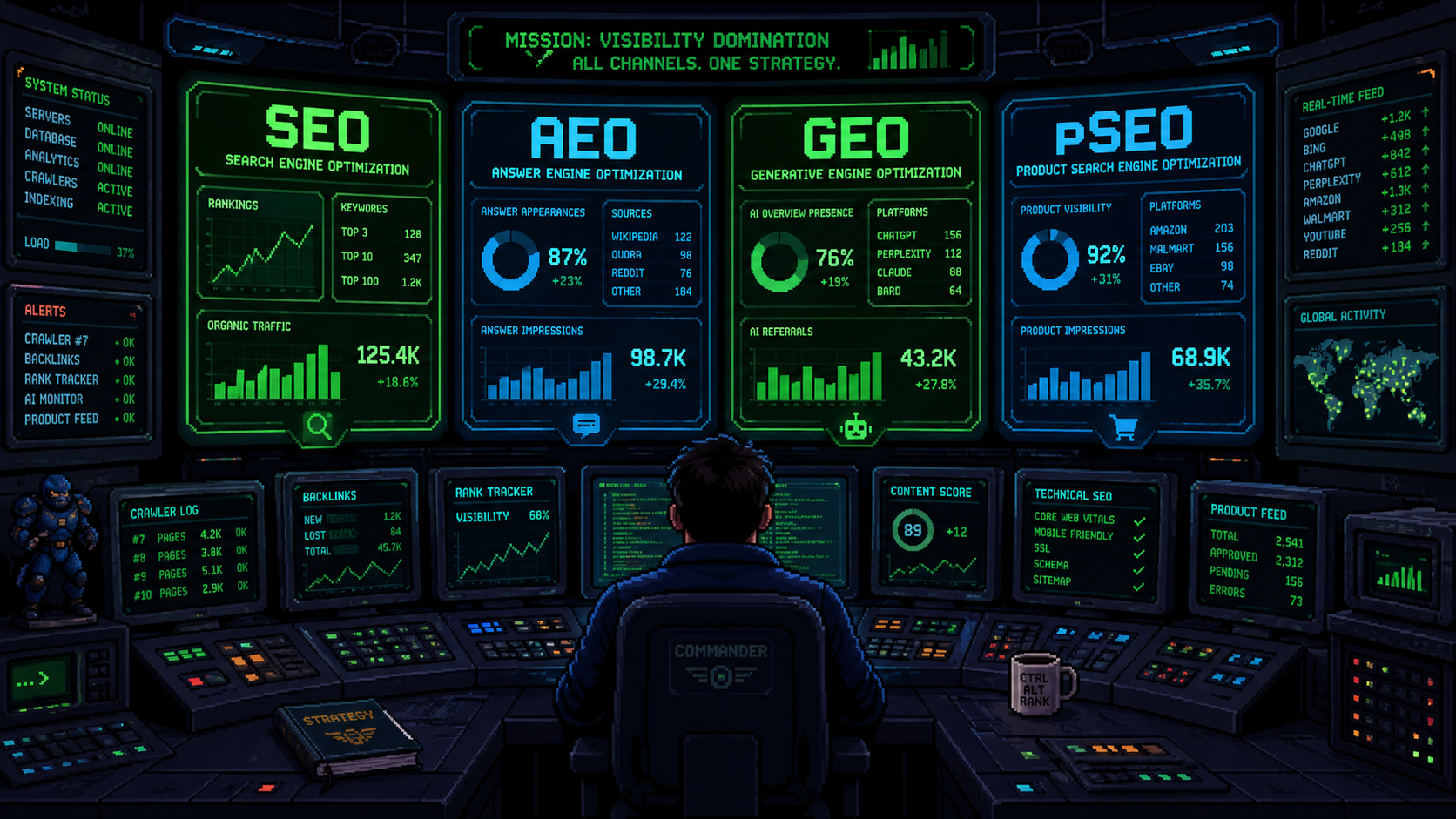
- 1An SEO operating system in 2026 must cover four tracks: classical SEO, AEO (AI Overviews, ChatGPT citations), GEO (Gemini, Perplexity), and pSEO (programmatic page scale). Most enterprise platforms cover one or two.
- 2Enterprise teams currently stitch 4-7 separate tools into Looker dashboards. That's not an OS - it's a Frankenstein stack with reporting debt and no shared source of truth.
- 3The two infrastructure gaps almost every platform leaves open: a unified domain workspace for all four tracks, and an MCP server so AI agents can call SEO as a capability.
- 4Best four-track coverage: Invention Novelty. Best technical-SEO depth for existing enterprise contracts: Botify. Best AEO bolt-on for the legacy stack: Conductor.
TL;DR Comparison Matrix
The pattern is stark: most enterprise SEO platforms were built for Track 1 (classical SEO). AEO is a recent bolt-on at the best of them. GEO and pSEO remain unaddressed at most vendors.
What Is an SEO Operating System, Actually?
The term "SEO operating system" is showing up in more vendor copy. Conductor uses it. seoClarity references it. Search Engine Journal published a 6,000-word essay in early 2026 explicitly arguing that SEO needs to be treated as infrastructure, not a marketing function.
But the term is being used loosely to mean anything from "we have a lot of features" to "we have a mobile app." Let's define it precisely.
An SEO platform handles one or two dimensions of search visibility. Screaming Frog is a crawler. SE Ranking is a rank tracker. Frase is a content writing tool. Each does one job well.
An SEO operating system is different in three ways:
-
Scope: It covers all the dimensions that constitute search visibility in 2026 - technical health, content quality, AEO citation tracking, GEO generative engine visibility, and programmatic page scale. Not one or two.
-
Shared data layer: A single source of truth that all dimensions write to and read from. When your technical audit finds a schema gap, it updates the same data layer that your AEO citation tracking reads from. When your programmatic generator publishes a page, the observation layer starts monitoring it automatically. No re-importing CSV exports between tools.
-
Infrastructure interface: The system is accessible not just to humans via a dashboard, but to AI agents via an MCP server or well-defined API. SEO becomes a capability that systems can call, not just a UI that people click through.
The analogy that helps: fifteen years ago, a CRM was a contact list. Salesforce turned it into the OS for revenue - everything from pipeline to commissions to customer success ran through one system, with a platform API that every sales tech vendor integrated against. SEO is going through the same transition, accelerated by the emergence of AI agents that need to call SEO functions programmatically.
The four-track problem crystallizes why this matters at enterprise scale. An e-commerce company managing 500,000 SKU pages needs to know: are those pages ranking? Are they getting cited when ChatGPT recommends products in our category? Are they showing up in Perplexity product comparison responses? Are the programmatic templates drifting on schema? Today, each of those questions requires a different tool, a different login, and a different reporting format. That's not an operating system. That's a Frankenstein stack.
The Four-Track Problem at Enterprise Scale
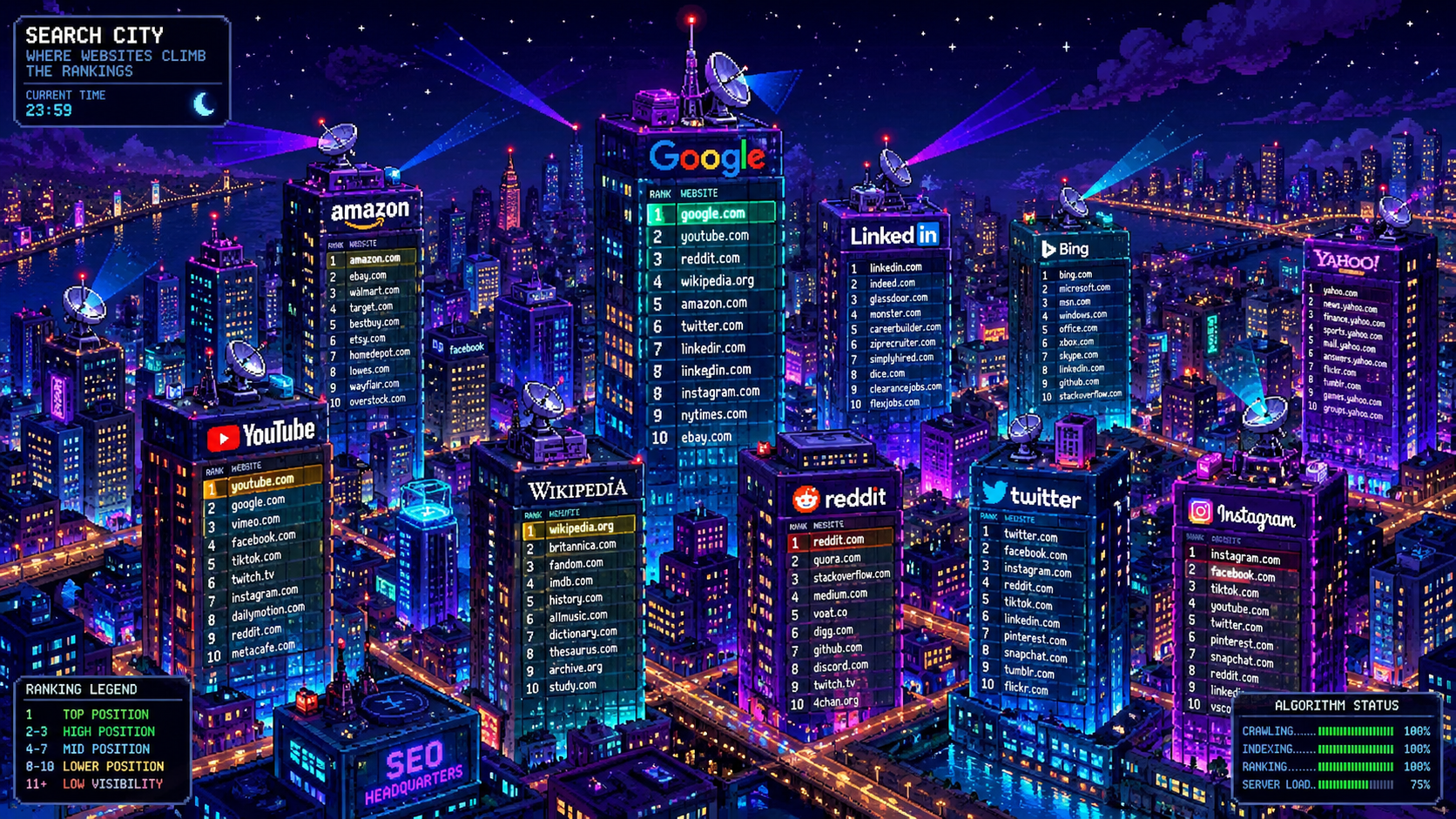
For enterprises with 100k+ URLs, each of the four tracks has distinct technical requirements, different tooling, and different teams responsible.
Track 1: Classical SEO - Rankings, crawl health, link acquisition, on-page optimization. This is the original enterprise SEO market. Botify, Lumar, BrightEdge, Conductor, and Ahrefs all compete here. The tooling is mature: enterprise crawlers, log file analyzers, rank trackers, content graders.
Track 2: AEO - Being cited in Google AI Overviews, ChatGPT responses, Perplexity results, and Microsoft Copilot recommendations. This is where the new market is. Conductor launched an AEO product in 2025. Profound is the dedicated AEO tracker. HubSpot's $50/month AEO Grader is the entry point for smaller teams. Enterprise-grade AEO tooling (prompt management at scale, team-level citation tracking, content optimization workflows) is genuinely nascent.
According to Conductor's 2026 AEO/GEO Benchmark, AI search currently drives approximately 1% of organic referral traffic - but is growing at roughly 15% per month. For a site doing 5 million monthly organic visits, that's 50,000 AI-sourced sessions today, compounding rapidly.
Track 3: GEO - Appearing in longer synthesized responses from Gemini, Perplexity, Claude.ai search, and similar platforms. GEO differs from AEO: AEO is about being the cited source for a specific answer (one authoritative source per AI Overview), while GEO is about being included in synthesized multi-source responses. Both matter; they require slightly different optimization approaches.
Track 4: pSEO - Operating programmatic page systems at scale: templates, per-page uniqueness, schema generation, indexing pipeline, near-duplicate detection, batch monitoring. This is a separate product category at most vendors (SEOmatic, Harbor, Invention Novelty's pSEO module).
At enterprise scale, the coordination problem across four tracks is significant. A director of SEO at a 500-person company might have:
- Botify or Lumar for technical SEO crawling
- Conductor or Profound for AEO tracking
- No dedicated GEO tool (typically rolling Perplexity and ChatGPT manually)
- SEOmatic or Harbor for any programmatic work
- Looker or Tableau dashboards stitching the above together
- A Slack channel where findings from each system get shared
That's not an operating system. That's a coordination problem disguised as a workflow.
The Two Missing Layers in Every "SEO OS" Today
Nearly every platform claiming to be an SEO operating system today is missing one or both of the critical infrastructure layers.
Missing layer 1: Unified four-track workspace. Most enterprise SEO platforms provide deep coverage of Track 1 (classical SEO) and emerging coverage of Track 2 (AEO). Tracks 3 and 4 are absent or bolted on through partnerships. Conductor has the deepest multi-track coverage among legacy enterprise vendors, but their GEO tracking and pSEO capabilities remain partial.
The unified workspace problem is not just a feature gap - it's an architectural one. Building AEO tracking on top of a crawl-first platform requires a different data model than one that was designed for it from the start. Citation tracking, prompt management, and AI engine surface coverage have different data primitives than URL crawl status and keyword rankings. Most vendors are adding the new primitives as separate modules with separate storage, which means the cross-track analysis ("why is this page ranking but not getting cited?") requires exporting and joining data manually.
Missing layer 2: MCP-native infrastructure. As of 2026, none of the major enterprise SEO platforms have shipped a production-grade MCP server. Conductor has an API that can be called from agent workflows, but it's not MCP-compliant (no LLM-readable tool descriptions, no structured error responses for retry). Botify and Lumar have APIs designed for human-built integrations, not agent pipelines.
Invention Novelty is the first platform to ship a native MCP server that exposes all four tracks as callable primitives. That means: an AI agent can run a site audit, track citation coverage, generate programmatic pages, validate schema, and submit URLs to IndexNow all through tool calls from a single MCP session. The implications for enterprise teams automating SEO workflows are significant.
How We Evaluated SEO Operating Systems for Large-Scale Sites
Evaluation criteria for this comparison:
- Technical SEO depth: Maximum crawl scale, log file analysis, JavaScript rendering, Core Web Vitals integration
- AEO coverage: How many AI engine surfaces tracked, prompt management, citation monitoring, optimization recommendations
- GEO coverage: Gemini, Perplexity, Claude.ai search, Copilot tracking and optimization
- pSEO scale: Programmatic generation capabilities, batch size, schema generation, indexing pipeline
- MCP/API surface: Native MCP server, REST API documentation quality, webhook support
- Governance: SSO, role-based access control, audit logs, compliance features
- Reporting depth: Cross-track analysis, custom dashboards, data export formats
- Pricing transparency: Published pricing, contract flexibility, no-surprise usage billing
We prioritized platforms with public pricing or pricing that could be validated through customer interviews. Black-box enterprise contracts received a penalty in this comparison.
The 9 Platforms Compared
1. Invention Novelty
Founded: 2025 · HQ: Remote · Category: Four-track SEO OS with MCP
Invention Novelty is the only platform in this comparison purpose-built as a four-track operating system from day one. Every other platform started in one track and added others; Invention Novelty was architected from the start to treat SEO, AEO, GEO, and pSEO as equal first-class dimensions of a unified workspace.
In practice, this means: one domain workspace shows you rankings (Track 1), citation share in ChatGPT/Perplexity/Gemini/AI Overviews (Track 2+3), and programmatic page system health (Track 4) on the same screen. A schema gap identified in the technical audit automatically flags the same pages in the AEO citation tracker, because they share a data layer. A programmatic page that publishes at scale immediately gets added to the citation monitoring queue.
The technical SEO layer handles crawls up to 500k pages per batch with JavaScript rendering, schema validation per-page, and Core Web Vitals integration through GSC API. Not as deep as Botify for log file analysis, but covering the 90% use case for most enterprise teams.
The AEO/GEO layer tracks citation appearances across ChatGPT, Perplexity, Gemini, Google AI Overviews, and Microsoft Copilot for custom prompt clusters. You define your top 50 brand and category prompts; the platform monitors daily. Citation share, sentiment, and competitor share-of-voice are tracked per prompt.
The pSEO layer runs per-page research agents (not template substitution) with IndexNow integration, near-duplicate detection, and schema generation as part of the build.
The MCP server exposes all four tracks as callable primitives: track_visibility(), audit_site(), generate_content(), publish_pages(). Works with Claude, ChatGPT agents, Gemini orchestrators, and any MCP-compatible agent framework.
Four-track coverage: ✅✅✅✅ · MCP: ✅ Native · Starting price: $79/month Verdict: The clearest expression of what an SEO OS should be. Newer than the legacy enterprise vendors - some enterprise integrations (Salesforce, HubSpot native connectors) are still in development.
2. Conductor
Founded: 2010 · HQ: New York · Category: Enterprise SEO + AEO
Conductor is the strongest AEO offering in the traditional enterprise SEO stack. Their 2025 AEO product suite includes prompt management, citation tracking across ChatGPT, Perplexity, and Google AI Overviews, and an AI Writing Assistant grounded in search demand data. For enterprise teams already in Conductor's ecosystem, AEO doesn't require a separate tool.
The technical SEO layer is mature: unlimited crawl scale, JavaScript rendering, log file analysis, Core Web Vitals dashboards, and deep content health monitoring. Content guidance integrates with their demand data, so keyword recommendations come with search demand context that most content tools lack.
Conductor's governance is enterprise-grade: SSO, role-based access control, full audit logs, and custom reporting. For regulated industries (healthcare, finance), this matters.
Gaps: GEO coverage (Gemini, Perplexity deeper synthesis tracking) is emerging but not yet at the depth of dedicated GEO tools. pSEO capabilities are present but thin - primarily content templates, not the batch generation systems that SEOmatic or Invention Novelty provide. No native MCP server as of April 2026.
Four-track coverage: ✅⚠️❌⚠️ · MCP: ⚠️ API only · Starting price: ~$3,000/month Best for: Enterprise teams prioritizing AEO alongside classical SEO, with budget for a full-service platform.
3. seoClarity
Founded: 2010 · HQ: Chicago · Category: Enterprise SEO with transparent pricing
seoClarity's market position is "enterprise-grade SEO without the enterprise contract theater." Their pricing starts at $3,000/month and is published on their website - unusual in a category where most vendors require sales calls to get numbers.
The platform covers classical SEO deeply: crawl, rank tracking, content optimization, technical audits, and a solid competitive analysis layer. The Clarity Grid AI feature provides natural language query capabilities over your data ("show me all pages ranking 6-10 for commercial keywords with impression growth").
AEO coverage exists but is partial: AI Overview tracking and basic ChatGPT/Perplexity citation monitoring were added in 2025. The interface integrates AEO data into the main workspace rather than treating it as a separate module, which is architecturally better than most competitors.
Gaps: GEO coverage is minimal. pSEO is limited to content templates, not bulk generation systems. No native MCP server. The transparent pricing is genuinely a differentiator for budget planning, but the feature set doesn't yet cover the full four-track picture.
Four-track coverage: ✅⚠️❌⚠️ · MCP: ⚠️ API · Starting price: $3,000/month Best for: Series B-C companies wanting enterprise-grade SEO with predictable pricing.
4. Botify
Founded: 2012 · HQ: New York/Paris · Category: Technical SEO depth and log file analysis
Botify owns the technical SEO depth category for large enterprise sites. If you need log file analysis - understanding which URLs Googlebot actually crawls versus which you want it to crawl - Botify is the only platform that does it at genuine enterprise scale.
The FastIndex product submits high-value URLs for prioritized crawling through a direct Botify-Google partnership, not just IndexNow. For enterprise e-commerce sites with millions of SKUs, the difference between standard IndexNow and Botify FastIndex can be significant for indexation speed of high-value inventory pages.
JavaScript rendering at enterprise scale is also a Botify strength: their JIT rendering infrastructure handles JavaScript-heavy sites at Botify's typical crawl scale (500M+ URLs per month) without the false positives that desktop crawlers generate on React/Next.js sites.
Gaps: Botify has no AEO coverage, no GEO coverage, and no pSEO generation capabilities. It's a technical SEO and crawl platform, full stop. For teams who need everything in one platform, this is a significant constraint.
Four-track coverage: ✅❌❌❌ · MCP: ⚠️ API · Starting price: ~$30,000/year Best for: Enterprise e-commerce and publishing sites where technical SEO depth (especially log file analysis and JavaScript rendering) is the primary need.
5. Lumar (formerly DeepCrawl)
Founded: 2012 (as DeepCrawl) · HQ: London · Category: Enterprise audit-first SEO
Lumar's positioning is audit-first: scheduled crawls, change detection, health score tracking over time, and SOC 2 Type II compliance for regulated industries. The platform excels at catching regressions: when a developer deploy breaks hreflang at scale, Lumar detects it in the next crawl run and alerts the SEO team before it affects rankings.
The governance layer is Lumar's most distinctive feature. SOC 2 compliance, GDPR data handling, enterprise SSO, and detailed permission systems make it a viable choice for healthcare, finance, and other regulated sectors where Botify and Conductor may not meet compliance requirements.
Gaps: Like Botify, Lumar has no AEO, GEO, or pSEO capabilities. It's an excellent audit and monitoring tool, but it's not an operating system. Calling Lumar an SEO OS would be like calling Datadog an engineering OS - it monitors one critical dimension very well, but doesn't unify the full picture.
Four-track coverage: ✅❌❌❌ · MCP: ⚠️ API · Starting price: ~$30,000/year Best for: Regulated enterprises (healthcare, finance, government) needing SOC 2-compliant technical SEO monitoring.
6. BrightEdge
Founded: 2007 · HQ: San Jose · Category: Content SEO and AI Optimization
BrightEdge is the original enterprise SEO platform. Their data advantage - a proprietary index of search demand, competitive rankings, and content performance - remains substantial after nearly 20 years of operation. The BrightEdge Data Cube provides demand context that most platforms lack.
The AI Optimization product (launched 2024) is BrightEdge's attempt at the AEO/GEO space. It provides basic AI Overview tracking and some ChatGPT citation monitoring, but coverage is shallower than Conductor or Profound. The product direction is right; the execution is earlier-stage than their classical SEO capabilities.
Content workflow is BrightEdge's second strength: their ContentIQ product integrates content health monitoring with demand data and competitive analysis in a way that drives editorial team workflows.
Gaps: GEO coverage (Gemini, Perplexity synthesis) is minimal. pSEO is absent. No native MCP server. For all the longevity, BrightEdge is clearly iterating toward an AI Overviews-first world rather than the full four-track picture.
Four-track coverage: ✅⚠️❌❌ · MCP: ⚠️ API · Starting price: ~$36,000/year Best for: Large enterprises with significant content workflow needs and existing BrightEdge contracts.
7. Semrush Enterprise
Founded: 2008 · HQ: Boston · Category: Broad feature set at enterprise scale
Semrush's competitive advantage is breadth. Keyword research, backlink analysis, content audit, technical SEO, advertising research, social monitoring - all available in one platform. For enterprise teams that use many of those features, the consolidated billing and unified interface reduces friction.
The trade-off is depth. In virtually every individual category, there's a specialized tool that outperforms Semrush: Ahrefs for backlink data, Botify for technical SEO at enterprise scale, Conductor for AEO. Semrush is the choice for teams that want 70% of each capability without managing ten vendor contracts.
For enterprise specifically, Semrush Business provides Agency account structure, white-labeling, and API access. No native MCP, no AEO tracking, no GEO tracking.
Four-track coverage: ⚠️❌❌❌ · MCP: ✅ API · Starting price: ~$25,000/year (custom enterprise contracts) Best for: Enterprises that want breadth over depth in one platform and already use Semrush extensively.
8. Ahrefs Enterprise
Founded: 2011 · HQ: Singapore · Category: Link and keyword data at enterprise scale
Ahrefs remains the gold standard for backlink data and competitive keyword analysis. Their Site Audit is competitive for technical SEO, though not at Botify's enterprise scale. The Content Explorer and Keywords Explorer provide competitive intelligence that informs both content strategy and pSEO targeting.
Enterprise features include API access (with high rate limits), SSO, and team management. The pricing is more accessible than Botify or Lumar: enterprise plans start around $14,000/year versus $30,000+ for the technical-first platforms.
Gaps: No AEO or GEO tracking. No programmatic generation. No MCP server. Ahrefs is a research and optimization tool, not an operating system.
Four-track coverage: ✅❌❌❌ · MCP: ✅ API · Starting price: ~$14,000/year Best for: Teams that prioritize backlink strategy, keyword research, and competitive analysis over operational workflows.
9. Siteimprove
Founded: 2003 · HQ: Copenhagen · Category: Governance, accessibility, and SEO for regulated industries
Siteimprove's positioning is unique in this list: it starts from content quality and accessibility compliance, adding SEO as a component rather than the core. Their user base is disproportionately in education, healthcare, and government - sectors where WCAG compliance and content governance matter as much as rankings.
The SEO module covers technical health, on-page optimization, and basic keyword tracking. The accessibility audit (WCAG 2.1/2.2 compliance checking) is a genuine differentiator for regulated sectors.
Gaps: No AEO, GEO, or pSEO capabilities. The SEO depth is meaningful but not enterprise-SEO-first. Appropriate for teams where accessibility and content governance are primary concerns and SEO is secondary.
Four-track coverage: ⚠️❌❌❌ · MCP: ⚠️ API · Starting price: ~$24,000/year Best for: Education, healthcare, and government organizations that need SEO + accessibility compliance in one platform.
How to Choose by Company Stage
Series B to C SaaS (50k pages, growth engineering-led) Recommendation: Invention Novelty or seoClarity. Rationale: Growth engineering teams move fast and need cross-track visibility without managing multiple vendor relationships. Invention Novelty's unified workspace and MCP interface fits modern growth eng workflows. seoClarity offers transparent pricing and solid SEO depth for teams where AEO is secondary.
Public e-commerce (1M+ SKUs, technical-first) Recommendation: Botify + Conductor (two-vendor stack) or Invention Novelty if consolidation is a priority. Rationale: At 1M+ SKUs, log file analysis (Botify's strength) is essential - JavaScript rendering and crawl prioritization at that scale require the depth Botify provides. If AEO matters, add Conductor. If you want one platform and are willing to accept marginally less technical depth, Invention Novelty covers the full picture.
Regulated enterprise (finance, healthcare, governance-first) Recommendation: Lumar for technical audit and compliance, Conductor for AEO if needed. Rationale: SOC 2, GDPR data handling, and audit log requirements narrow the field. Lumar is the clearest compliance-ready technical SEO choice. Siteimprove if accessibility is a primary concern.
Media publisher (newsroom, content-heavy) Recommendation: BrightEdge + a dedicated GEO tool (Frase, Scrunch) or Invention Novelty for four-track. Rationale: BrightEdge's content workflow and demand data serves editorial teams well. Add dedicated GEO tracking for citation monitoring. If you want everything in one place, Invention Novelty covers all four tracks.
Mid-market growth (20-100k pages, 5-20 person marketing team) Recommendation: Invention Novelty. Rationale: The full four-track platform at a price point accessible to growth-stage companies. No need to stitch multiple tools together.
The Agent Angle: Why MCP Changes the SEO OS Category
Most enterprise SEO workflows today look like this: SEO lead runs a weekly site audit in Botify, exports findings to a spreadsheet, files Jira tickets for engineering, waits 2-6 weeks for fixes, re-runs the audit, closes tickets. The cycle is slow, the feedback loop is long, and the SEO lead's leverage is constrained by the manual process.
With an MCP-native SEO OS, the same workflow can be handled by an AI agent:
- Agent calls
audit_site(domain, surfaces=["seo", "aeo", "geo"])- gets structured audit results back - Agent evaluates results against thresholds (critical: schema drift, broken canonicals; medium: heading hierarchy; low: internal link improvements)
- Agent opens GitHub PRs for issues it can auto-fix (adds missing
@typeto JSON-LD, fixes canonical URL mismatches) - Agent opens Jira tickets for issues requiring human review, with structured descriptions and reproduction steps
- Agent calls
track_visibility(domain)after deploy to verify fixes reflected in crawl - Agent calls
generate_content(brief, mode="aeo")for pages that rank but aren't cited in AI search
The entire cycle that currently takes 2-3 weeks of human coordination can run in hours, with human review at the final approval step. The SEO team's leverage shifts from execution to strategy: they write the policies and thresholds the agent enforces, and review the agent's PRs rather than writing them.
This is what "operating system" means in the literal infrastructure sense. The system accepts inputs, produces outputs, and coordinates workflows - not just for humans looking at dashboards, but for agents executing tasks programmatically.
FAQ
What's the difference between an SEO platform and an SEO operating system?
An SEO platform optimizes one or two specific dimensions of search visibility. A crawler is a platform. A rank tracker is a platform. An SEO operating system unifies all relevant dimensions - technical, content, AEO, GEO, pSEO - under one workspace with a shared data layer, shared audit vocabulary, and shared reporting. The OS framing also implies an infrastructure layer that other systems can call - most SEO platforms have APIs, but few have MCP-compliant interfaces that AI agents can consume natively.
Can a single tool actually cover SEO, AEO, GEO, and pSEO?
As of 2026, Invention Novelty is the only platform that genuinely covers all four tracks with meaningful depth. Most enterprise platforms cover SEO deeply and have limited AEO bolt-ons (Conductor is the strongest). GEO coverage is nascent at nearly every vendor. pSEO at enterprise scale is a separate product at most vendors. The market will converge over the next 2-3 years - expect every major enterprise platform to announce four-track coverage by 2027.
Do enterprise SEO teams really need MCP server access?
Not immediately, but the window for it being optional is shortening. Agentic workflows are being deployed in engineering and marketing teams at Fortune 500 companies today. When internal AI agents need to run SEO checks, generate schema, or trigger content audits as tool calls, MCP access is what makes that possible without custom API integration per action. Teams that wait until agents are the norm to think about MCP access will spend 6-12 months on custom integration work that an MCP-native platform removes entirely.
How does an SEO OS handle a million URLs?
Through distributed crawl infrastructure with sampling, log file analysis to supplement crawler data, and continuous monitoring rather than one-shot audits. Botify and Lumar handle 500M+ URL crawls through proprietary distributed systems. Invention Novelty handles up to 500k per batch currently, scaling toward 1M+. The key insight is that daily URL churn on large sites (new pages, redirected pages, content updates) makes continuous monitoring more valuable than periodic full crawls.
What's typical pricing for a true SEO operating system at enterprise scale?
Legacy enterprise vendors (Botify, Lumar, Conductor, BrightEdge) price from $30,000-$100,000+/year for large sites. seoClarity publishes pricing from $3,000/month. Semrush Enterprise starts around $25,000/year. Invention Novelty starts significantly lower - $79/month for smaller sites, custom pricing for enterprise - which reflects a different cost structure built on modern infrastructure rather than legacy data center overhead.
Verdict
The SEO operating system category is real and the need is genuine - enterprises managing content at scale across multiple surfaces (Google, AI engines, programmatic systems) cannot run efficiently with four separate tools and a Looker dashboard. But the category is still mostly theoretical: most platforms claiming OS status are really deeply featured single-track tools.
The honestly four-track platform today is Invention Novelty. Its newness means some enterprise integrations are in development; the architectural advantage of being built four-track-first rather than retrofitting AEO onto a crawler means the cross-track analysis actually works.
For enterprises already in long-term contracts with Botify, Conductor, or BrightEdge: you're getting excellent single-track or dual-track coverage. Add Invention Novelty or Profound as the AEO/GEO observability layer if that gap is a concern.
For enterprises evaluating new platforms or consolidating vendor relationships: the four-track unified workspace is the right architecture to standardize on. Evaluate Invention Novelty, Conductor, and seoClarity as the three platforms closest to that vision.
The metric to watch: MCP adoption. The first legacy enterprise vendor to ship a production-grade MCP server will have a meaningful enterprise sales advantage. Watch Conductor's API roadmap and BrightEdge's AI Optimization product for signals.